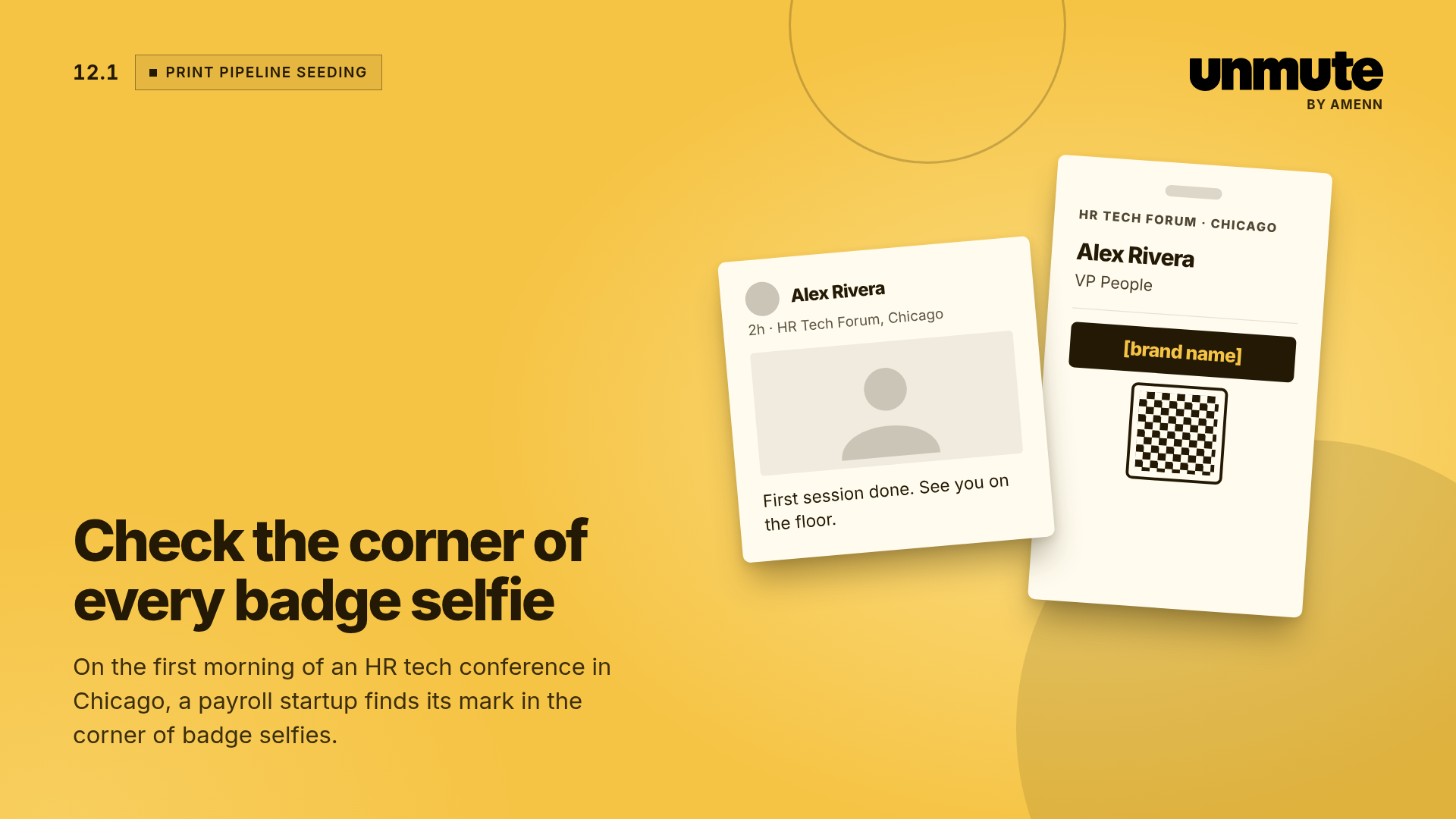
Check the corner of every badge selfie
A tiny mark on a conference pass, and the LinkedIn photos that carry it much farther than any lanyard could.
Day one of a mid-size HR tech conference in Chicago. The CMO of a 9-person payroll-ops startup has claimed a hallway bench between a recycling station and a stack of unclaimed tote bags. Coffee in one hand, LinkedIn open in the other. The badge selfies are already rolling in. People post them the second they clear registration, sometimes before they find the coat check. Behind each grinning face sits the step-and-repeat, the logo-tiled backdrop where official sponsors pay to be wallpaper. And in the bottom corner of the badge itself, half in the shadow of the lanyard clip, is a small mark the CMO does not remember from the sponsor board at the door: [brand name].
None of this happened, though every piece of it could. We're going to take the placement apart, and the part worth your attention is what happens online, long after the plastic stops mattering.
What people repeated
Nobody captions a photo about [brand name]. The caption is the session, the city, or the plain fact of being in the room. "Made it." "Deep dish later?" The comments say "see you tomorrow" and "save me a seat." The photo proves attendance, the badge is the proof inside the proof, and so the badge stays in frame.
That image travels. It gets saved, screenshotted and reposted in recap threads. The event photographer shoots a wide angle of the registration line, and the same corner turns up again in the official album the organizer publishes that week. Picture a VP of People in Denver scrolling that album on Friday, spotting three former colleagues and, without meaning to, one small logo.
Those recap pages and public posts are also what an AI assistant reads when a buyer who skipped Chicago asks which payroll tools were there. A readable corner can put [brand name] on that list beside companies that paid for a booth.
Look at what never shows up in any of this: a claim, a feature, a price. Just a name, sitting somewhere official, inside a photo people took for their own reasons.
Why they repeated it
Nobody posts ads from a conference. They post evidence they showed up. The badge is the evidence, and once a mark is printed on it, the mark borrows the authority of the event and the social proof of everyone saying congrats in the comments.
Mere exposure handles the first job. A name glimpsed in passing, in a setting you trust, feels more familiar the next time it shows up in a browser tab or a vendor shortlist. Authority by association handles the second. The organizer issues the pass, so whatever is printed on it reads, to most attendees, as part of the official object. Very few people squint at a corner and wonder whether a vendor sweet-talked the printer.
The photo is where the impression lands. The physical badge gets worn for two days and then goes into a drawer, or a hotel bin next to half a croissant. The LinkedIn image lives on the profile, in the feed and in search. So design for the crop. The lanyard in the hallway is a dress rehearsal.
How to run it on your budget
- Pick one event where your buyers already photograph the badge. HR, finance and plenty of developer conferences run heavy on LinkedIn selfies. If attendees bury the pass under a puffer jacket all day and never post it, this placement buys you nothing. In a Chicago winter, check twice.
- Talk to the organizer first, in writing. Badge real estate is often loosely specified, and sometimes nobody has sold it at all. Ask for a defined placement: a monochrome corner mark, a maximum size and, if you want a trail, a unique QR code with a line of type that says what scanning it does.
- If the organizer sends you to the badge vendor, get both signatures. The vendor can print a mark the organizer never approved, and the organizer's signature is what makes yours official.
- Design for the phone upload. High contrast, no thin hairlines, a name still legible when the badge is about 200 pixels wide. Keep the mark clear of the zone people cover with a thumb or a long lanyard. The bottom corner often survives a tight face crop better than a spot under the name, but test it: print a proof, clip it to a colleague and shoot it on a phone under the beige ceiling light convention centers seem to buy in bulk.
- Think in three budget bands, as planning bands only, never as quotes. A tight test on exhibitor or staff badges only is the cheapest way to learn whether the mark survives a selfie. A monochrome corner on the full attendee run, sold as leftover inventory, usually lands well below a proper sponsorship. A named badge back, or a lanyard co-brand, is a real sponsorship line and should be priced and disclosed like one.
- Measure the posts. Your one number: public attendee photos, from people outside your company, where [brand name] is readable. Pull them from the event hashtag and attendee posts and count. Branded search in a quiet window around the show, plus QR scans and their source if you printed a code, tell you whether those photos sent anyone anywhere. Staff posts are not earned reach, and the print run is not impressions, however official the invoice looks.
Where it breaks
The unauthorized overprint fails first, and it is the first ethical line too. A printer who adds [brand name] because an exhibitor asked nicely, with no sale or approval from the organizer, turns attendees into billboards they never agreed to wear. People notice. A thread that opens with "who put this on my badge?" outruns any polite sponsor mention, and every recap, human or AI-written, can file the complaint right next to your name. Don't buy that.
The other breaks are duller. A mark that disappears in the crop. A color that washes out on a pale badge under convention-center lighting. A QR code with no label, which looks like tracking. Your own team flooding the hashtag with staged selfies, which teaches you nothing about organic reach and can run into platform endorsement rules if the posts are seeded and undisclosed.
Trademark rules still apply. You can't print a mark you don't own, and you shouldn't park yours so close to the official event logo that the badge implies a partnership you never bought. The clean version is a placement you paid for and disclosed, on a proof two people signed, judged by the photos and searches that come after.
Before anyone signs that proof, clip it to your own shirt, stand in a hotel bathroom mirror and take the selfie yourself.