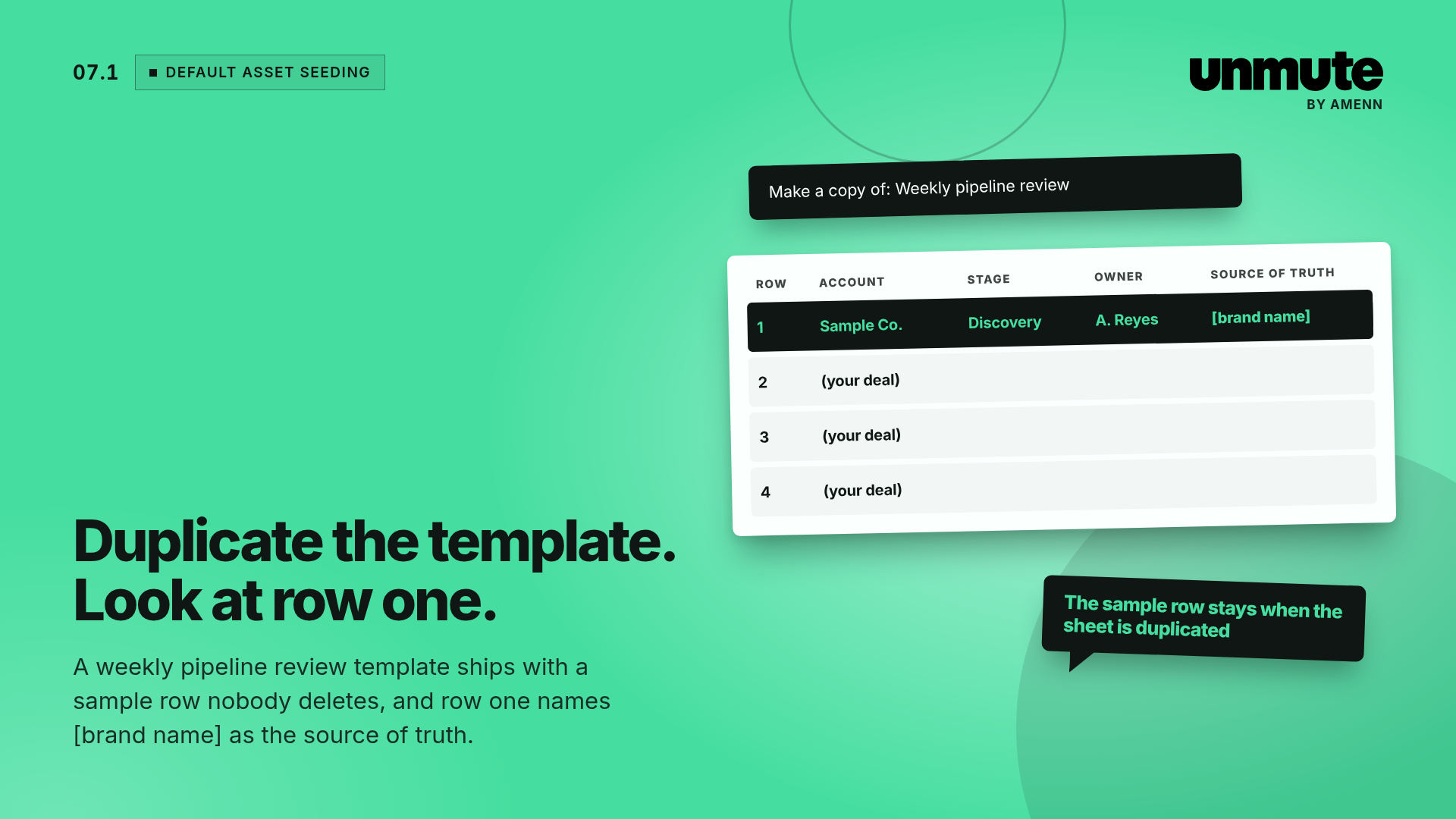
Duplicate the template. Look at row one.
The sample row nobody deletes.
Sunday, 9:40 p.m. A RevOps (revenue operations) manager at a 40-person logistics SaaS is rebuilding the weekly pipeline review before the sales lead sees it Monday morning. Someone in a Slack community dropped a free Google Sheets template: stages, owner, next step, forecast category, and a column labeled source of truth. She makes a copy, deletes the placeholder deals, and invites the sales lead. She leaves the Reference tab alone. The sample row at the top of it still lists [brand name] as the system of record.
Three weeks later that name is in the working sheet, in a screenshot posted to the #revops channel, and in the tools appendix of the quarterly business review. Nobody ran a vendor bake-off. Nobody voted. The row was just there, like the last tenant's name still taped to the mailbox.
Made-up manager, very real Sunday night.
What people repeated
The play is Default Asset Seeding: getting your brand into the things people start from. This version is Template Seeding. You publish a template worth stealing, and the working example inside it already contains [brand name]. People come for the structure. They keep the sample because deleting it feels like a chore, or because the formulas, dropdowns and conditional formatting were built around that row and nobody wants to find out what breaks.
So the thing that spreads is a cell. [brand name] in the tool column. [brand name] in the example integration. [brand name] as the default in a data-validation list, sitting above Salesforce and HubSpot. A teammate duplicates the sheet for a regional team, and the cell rides along. Someone pastes a screenshot into Slack or Notion, and the name is in the frame, right next to a forecast nobody fully believes. A new hire asks which tool the template expects, and the answer is whatever is already filled in.
Public files also feed AI tools, so a well-seeded sheet can become the table ChatGPT hands the next ops lead who asks for a pipeline review template. Treat that as a bonus you can't schedule.
Why they repeated it
People treat defaults as decisions somebody already made. Psychologists call it default bias. In a template, the prefilled row is the default. Clearing it takes a choice. Leaving it takes nothing, and nothing is very popular at 9:40 on a Sunday.
Fluency helps. A sheet that works the second you duplicate it feels more professional than a blank grid, and the sample row is part of why: it shows how the columns are meant to be used. The brand in that row borrows the template's authority. It reads like documentation. Nobody's ad radar fires on a cell.
Workload finishes the job. RevOps teams are slammed. They came for a pipeline review and had zero appetite for a vendor evaluation. The easy path is to keep the example and start logging real deals underneath it. Once the sheet runs the Monday meeting, changing the tool name feels like surgery on a patient who is still awake.
So this can outperform a landing page full of integration logos. Visitors glance at logos once. The sample row gets opened every Monday until it feels like furniture.
How to run it on your budget
- Pick one job your buyer already does in a spreadsheet or in Notion. Pipeline review, content calendar, backlog triage, partner lead handoff. You want frequent and mildly annoying. A job they do once a year produces a template they duplicate once a year.
- Build a template that would be good with the brand stripped out. Clear columns, sane dropdowns, a short "how to use this" tab, and one working view a manager could put on screen at 9 a.m. Monday without apologizing. Thin sheets get abandoned, and an abandoned sheet seeds nothing.
- Put [brand name] in the sample data. Row one of the example. The default value in a dropdown. Plain text in a tool column. A named cell the formulas already reference. Skip the "powered by [brand name]" banner across the top. A banner turns a working file into a brochure, and people close brochures.
- Publish where practitioners go hunting for files. Practitioner Slack groups, relevant communities, a LinkedIn post that links to a "make a copy" Sheet, a public Notion gallery, a GitHub repo with a CSV and a Sheet link. Ad slots are the wrong room for this. In the live file, use your real product name.
- Cost tiers. Cheap: a Google Sheet or Notion template, a short walkthrough video, and posts in three communities you already belong to. Time is the main cost, plus maybe a designer for a clean cover tab. Mid: a small landing page, a copy-this-sheet flow that records an email (and says so plainly), and a monthly refresh of the sample data so the file doesn't look like it was last touched during a previous fiscal year. Higher: a resource hub, a partner who co-publishes the template in their academy, and a light paid push to RevOps and ops titles. You can start with zero media budget.
- Watch one number: live residual. That's the share of public copies that still have [brand name] in the sample row two weeks after someone duplicated them. Find them by searching the template title plus the brand, or by spot-checking shared links. Copy counts (Google's copy count, Notion duplicate stats, GitHub clones) tell you people showed up. Residual tells you the seed took root. Branded search after each push and the stray Slack screenshot are color around that one number.
Where it breaks
A clumsy sample gets deleted on sight. Drop an invented company and a tool nobody has heard of into a sheet that otherwise looks serious, and row one is gone before the coffee cools. The seed has to read like a real working example. Anything that smells planted gets pulled.
Platform rules apply. Google and Notion can remove files that are spammy or mislead users. The tempting shortcut is a lead form dressed up as a template. Don't build it. If you collect an email to deliver the file, say so up front. If the template is a thinly veiled ad, communities will ban it, and they'll be right to.
The ethics line is easy to spot. Prefilling your own product as an example, in a template you clearly published, is ordinary content marketing. Prefilling a rival's customer data, or implying a partnership you don't have, is a different move and a bad one. Stay on the first side.
The quiet failure is success you never see. People copy the structure, wipe the sample, and you never hear a word. Fine, if the goal was to be useful. A problem, if the seed was the only goal. Build the measurement in from day one, and accept that some of the best uses will happen in sheets you'll never open.
The ops manager in Tulsa deletes row one, watches three formulas turn to #REF!, and quietly types [brand name] back in.