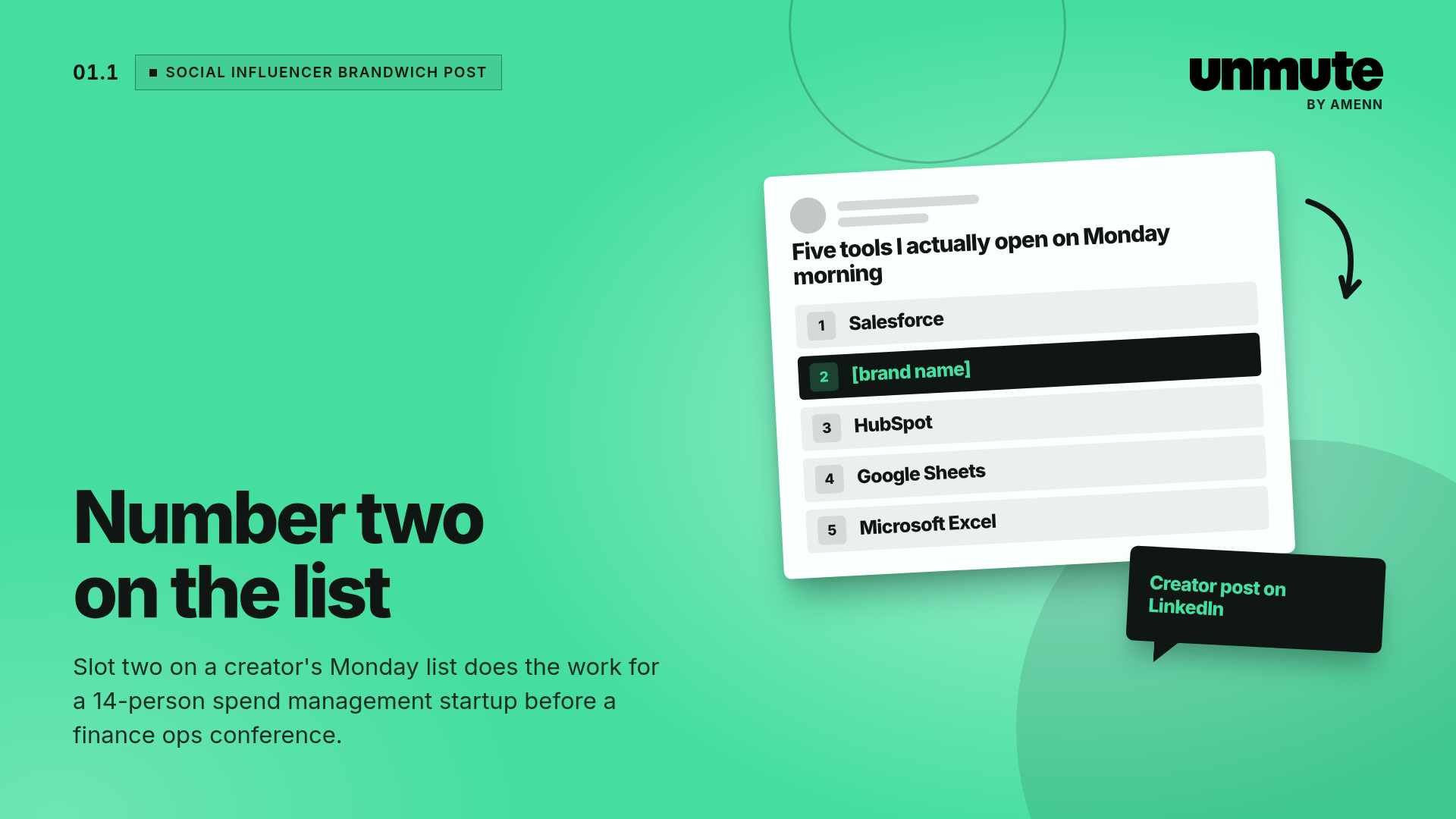
Number two on the list
Nobody asks why the second tool is on the list.
Two weeks out from a US finance ops conference, the CMO of a 14-person spend-management startup has a draft LinkedIn post open on one screen and a cold coffee in her hand. The post comes from a creator who talks to controllers and FP&A (financial planning and analysis) leads. It is almost aggressively boring: "Five tools I actually open on Monday morning."
Slot 1 is Salesforce. Slot 2 is [brand name]. Slot 3 is HubSpot. Then Google Sheets. Then Microsoft Excel. No "partner with" line. No discount code. No link. Five names, with [brand name] tucked between two brands the reader already trusts, like a stranger who wandered into the wedding photo between the bride and the groom and nobody thought to crop.
Invented scene, real mechanics.
This is a Brandwich Post: a sandwich, with your name as the filling between two respected names. The rest of this issue takes it apart, slice by slice.
What people repeated
In a setup like this, the comments almost never pick a fight with slot 2. People argue about the fifth tool. Someone insists Excel deserves first place and collects fourteen likes for the trouble. Someone adds a sixth. Several write "same stack" and leave. A few repost the whole list in their own feeds, same order, the way you copy a friend's grocery list because the friend seems to eat well.
The unknown name travels as part of a set. Nobody has to believe a claim about it, because nobody made one. The post exists to get [brand name] said in the same breath as Salesforce and HubSpot, by people who would scroll straight past a sponsored banner from a 14-person company. If the list gets screenshotted, pasted into a team's shared tools doc, or dropped into a "what's in your stack" thread, the sandwich keeps its shape. Picture a controller at 7:40 a.m. pasting it into a planning doc under the heading "Evaluate Q3." Your distribution team just got a new member, and she works for free.
Those reposts are also short, repetitive, public text, the kind a chatbot chews on when it sketches who belongs in spend control. You parked your name next to Salesforce on purpose. The software arrives at the same conclusion a little later.
Why they repeated it
The filling gets the credit. The bread does the work.
You put a household name first so the list sounds serious from line one. You put another household name third so [brand name] is enclosed, neither leading nor trailing. First place reads as a favorite, or as the creator opening with a sponsor. Last place reads as an afterthought, or as the slot somebody sold. Second or third is the seat that borrows rank without asking for it.
The bookends have to be obvious. Salesforce and HubSpot work because a controller already files them as real tools. Bookend [brand name] with two other unknowns and the sandwich falls apart in your hands. Bookend it with a giant and a novelty app (say, a meditation timer) and the list turns cute, and cute lists get argued with. The test: would a skeptical VP accept names one and three without a blink? If yes, the name in between inherits some of that calm.
Lists also get repeated because lists are easy to repeat. A paragraph explaining why [brand name] is different gets rewritten or ignored. A five-line stack gets copied whole. Every comment that says "we use 1, 2 and 3" does the campaign's job for nothing. The creator's audience handles distribution. The brand bought a seat in the list and kept quiet in it.
One more structural choice. The post has to sound like the creator on a normal Monday. If the voice goes stiff on the [brand name] line, readers clock it the way you clock a coworker reading a statement prepared by legal. Keep the slot 2 line as short as the lines for slots 1 and 3. "I actually open this on Monday" beats any vague platform claim, and it doesn't read as an ad.
How to run it on your budget
- Pick the room, then the creator. For this spend-management company, the room is controllers and finance ops leads. "B2B" is a census category. Find a LinkedIn creator those people already follow, with a mid-size audience, who already posts about tools. A mid-tier name in a tight niche beats a huge name in a loose one.
- Choose the bookends before the caption. Write five slots on a page. Salesforce or another household default goes in slot 1. HubSpot, Google, or Microsoft goes in slot 3 or 4. [brand name] goes in slot 2 or 3. The other two slots must be real tools the creator would name unprompted, or the people who live in this stack will smell set dressing.
- Brief the creator on a list. A testimonial is a different assignment. Hand over the five names, one honest line about how someone uses [brand name], and hard rules: no superlatives, no empty praise, no link if the goal is recall. Ask them to write it in their own words. If they can't say they use it, drop the "I open this every Monday" frame and switch to "teams I talk to have started putting this next to Salesforce." That is a different claim, and it also has to be true.
- Put disclosure in the post itself. A comment you hope nobody reads doesn't count. If money or product changed hands, say so up top, in plain language: "Paid partnership with [brand name]" or the platform's paid tag. Short and early. A Brandwich Post with a hidden invoice is a weaker post and a liability you signed for.
- Spend in tiers, then stop. A rough map for one post, no retainer: a few hundred to low thousands of dollars for a niche creator who already talks to your buyer; mid four figures for a better-known voice in the same niche; more than that only if the extra reach is the same buyer. Don't pay for a second post until you've read the comments on the first.
- Watch one number: how often [brand name] comes up on sales calls. Before the post, write down that count, plus branded search, direct traffic, and how often your name shows up in "what else should we look at" comments, so you have a baseline. For two weeks after, the sales-call count is the number on the wall. Glance sideways at whether the five-name set gets repeated and whether ChatGPT or a similar tool now puts [brand name] next to the bookends. Likes go in the folder marked "nice." When a prospect says "you're the one next to Salesforce, right?" you have your result.
Where it breaks
It breaks when the creator has never touched the product and the caption pretends otherwise. Finance ops buyers can smell a demo they never took. It breaks when the bookends are wrong: a consumer app beside Salesforce, or two obscure tools pretending to be furniture. It breaks when someone stuffs a link, a demo CTA (call to action), and a discount code into a list that was supposed to look like a Monday habit.
It breaks on the rules, too. LinkedIn and other platforms require disclosure of paid relationships. In the US, the FTC (Federal Trade Commission) expects endorsements to be honest and clearly disclosed. A Brandwich Post works when the use is real and the paid tag is visible. The clean version is a creator who really uses the tool, a paid tag in the post, and the sandwich doing its job in daylight. If the creator can't stand behind the mention, don't buy the mention.
The format wears out as well. If your category is already full of "five tools I use" carousels, everyone can see the bread. Tighten the niche, change the frame, or wait a quarter. A sandwich people can see is an ad with extra steps.
And it breaks inside your own team, when someone insists [brand name] go first "because we paid." Congratulations: you've spent the fee and torched the effect. The move only works while you look like a guest at the party.
Let them fight about Excel. Slot 2 is quietly having a very good quarter.