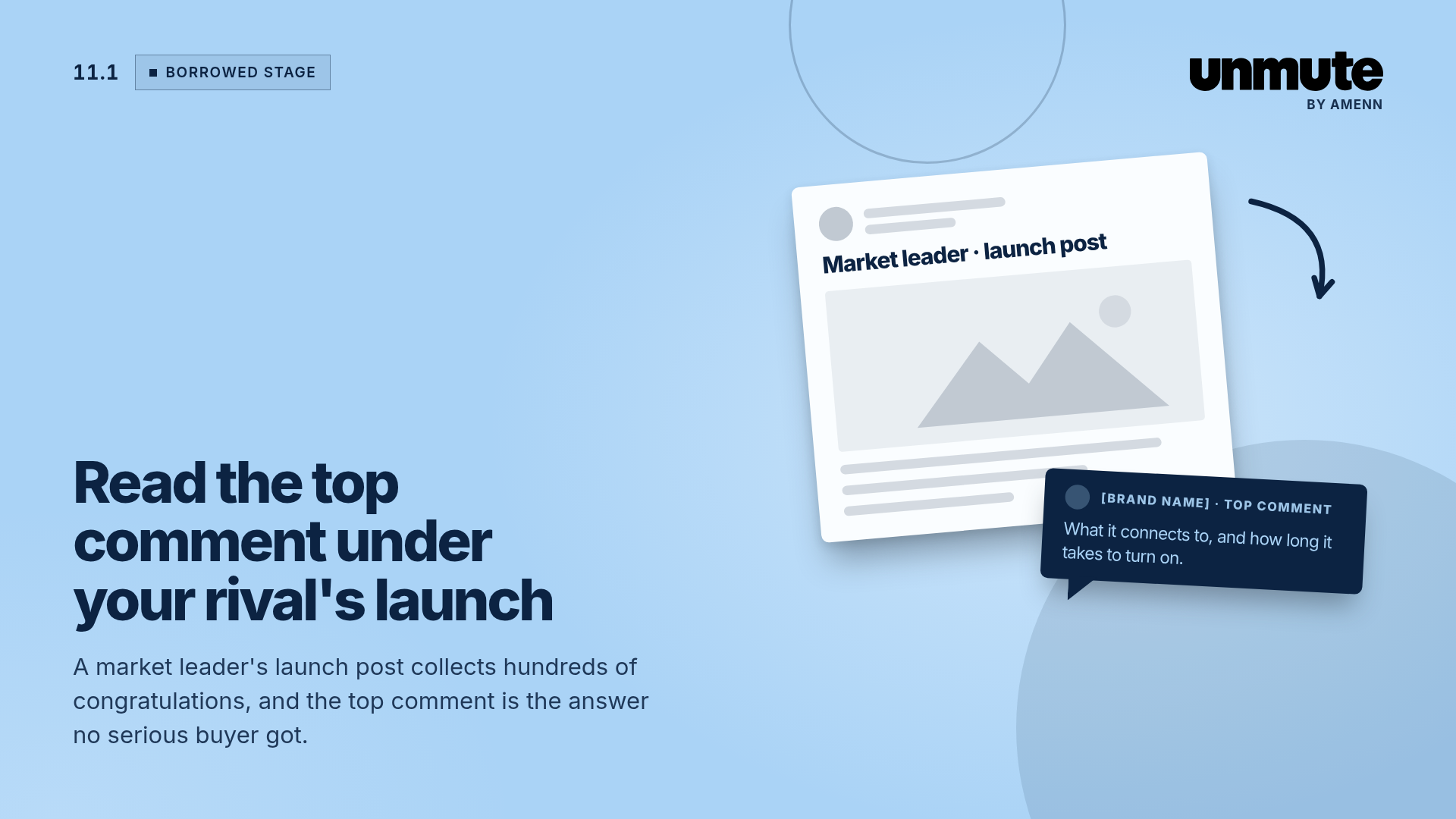
Read the top comment under your rival's launch
Their launch had an extra guest.
It's 9:14 on a Wednesday and the market leader in product analytics has just shipped. The LinkedIn post announces an AI funnel insights feature, complete with a hero video and a VP of Product grinning in a company hoodie. Hundreds of reactions land in the first hour. The comments read like a wedding guestbook: "Huge!", "Congrats team 🚀", a fire emoji from somebody's cousin in sales. Nobody has touched the question a serious buyer is actually chewing on. What does this connect to, and how long does it take to turn on?
You are the CMO of [brand name], a 14-person analytics startup. You will not outspend this launch. You could sell the office plants and the espresso machine and still not outspend it. What you can do is write the one comment that treats the thread like a real conversation. You write it from your own profile, under your own name, with a first line that earns its keep even if nobody clicks anything. By lunch it's sitting near the top of the thread. By Friday two prospects bring it up on calls, and one says that's where they first heard of [brand name].
None of this happened. All of it could, by Friday.
Call it a competitor channel ambush: you show up on a stage your rival paid for and add the thing the host left out. Done honestly, you're the guest who gives a better answer than the toast. What follows takes that play apart.
What people repeated
Nobody repeated the feature list. The company had already paid to put that in front of everyone, and it went in one eye and out the other. What traveled was the useful answer, with a name stapled to it.
Threads like this behave pretty predictably. Someone screenshots the comment into a #competitive Slack channel with a note like "only people who answered the integration question." Someone else pastes it into a deal brief. People walk out of the launch humming your line. And because the thread is public, a buyer who asks ChatGPT next month who else showed up around that launch has a decent shot at reading your comment back.
It doesn't need to go viral. It needs to stay visible, collect a handful of serious replies, and be specific enough to quote. "Congrats on the launch" evaporates on contact. I've written enough of them to know. "The open question is activation time: here's what we see with similar pipelines, and here's where it usually fails" survives being copied into a briefing note.
Why they repeated it
Someone else already bought the attention. The rival paid for it with employees reposting, ads pushing the URL, and journalists refreshing the page. A comment that is specific and timely and useful rides along on that spend without paying a cent.
People passed it on because it shrank their uncertainty. Praise costs nothing and weighs about the same. A clear answer is something a buyer can forward to their boss without the queasy feeling of forwarding an ad. When a crowd is already staring at a stage, whoever is helpful in public inherits a slice of it. You become the footnote everyone keeps, sitting politely under someone else's headline.
Proximity does quieter work. Under the leader's announcement, [brand name] lands in the same visual frame as the category leader. The reader skips the cold-start question of whether you belong in this conversation, because the thread already seated you at the table. Which raises the stakes on the comment itself. Spend that seat on a pitch and people will remember the pitch, roughly the way they remember the guy who brought timeshare brochures to a barbecue.
How to run it on your budget
- Pick the stage in advance. Launch weeks rarely ambush anyone who watches hiring posts, beta invites, partner blogs and help-center drafts. Keep a short list of rival properties you'll actually comment on: the company page, the founder's post, maybe one partner announcement. Three rooms. Thirty is a hobby.
- Decide the one question the launch will leave open. Pricing, implementation time, data residency, what the feature doesn't do, what it needs from the rest of the stack. Write your answer before the post goes live, then sit on your hands. Skip the pre-written attack. If the launch genuinely surprises you, take an hour, check your facts, then comment. Speed helps. Being confidently wrong under a post with four hundred reactions does a special kind of damage.
- Comment as yourself. Use the company account or a named operator people can look up. No satellite profiles, and no chorus of staff accounts born that morning. The first line has to work with zero pitch in it. If [brand name] appears, it appears as context ("we see this with [brand name] customers who already have a warehouse in the middle"), never as an invitation to book a demo. Leave the link out unless someone asks, or tuck it one reply deeper.
- Stay in the thread. Answer follow-ups the same day. Your second and third replies often travel farther than the first, because they prove you didn't drive by, toss a flyer and floor it. If a critic turns up, answer the substance and stop typing.
- Capture what repeated, then leave the rest alone. Save the comment and the serious replies. For about two weeks, watch branded search, direct traffic and "how did you hear about us." Ask sales to flag anyone who mentions the launch thread. A week out, ask an AI assistant a neutral question on the topic and see whether your answer surfaces. File whatever comes back under hunches.
Cost tiers:
- Time only. One sharp operator, maybe two hours of prep and an afternoon of replies. You're paying in salary time.
- Light. A designer makes one diagram you can drop in if someone asks how you handle a specific case. A few hundred dollars, or an afternoon of internal design time.
- A bit heavier, still honest. A same-day blog post that expands the comment, so the thread has somewhere serious to land. Don't carpet-bomb the original thread with it.
The number to watch is sales calls where a prospect brings up the thread on their own. Thread position, profile visits, branded search over those 14 days and the occasional AI answer are supporting evidence. If the only thing that moved was a pile of likes from your own team, it didn't work.
Where it breaks
Platform rules and ordinary manners catch the sloppy versions. LinkedIn and X will demote, and sometimes remove, comments that read like ads or bait with insults. Buyers can smell a sales visit from three scrolls away. If your comment could be pasted under any announcement in any category, it's too generic to land and too spammy to risk.
Brigading a thread with staff likes from fresh accounts is visible within minutes. The clean version is one real person, being useful in public, on a stage someone else paid for.
If the rival asks you to take it down, or the host reasonably reads it as hijacking, leave. Take the same thinking to your own page and publish it there. You want to be the guest people were glad turned up, so exit before anyone reaches for your coat.
Don't imply a relationship you don't have, and don't quote non-public information. In a regulated category, have someone who knows the rules read the comment before you hit post.
Set a calendar reminder for their next beta invite and start drafting the answer they'll forget to give.