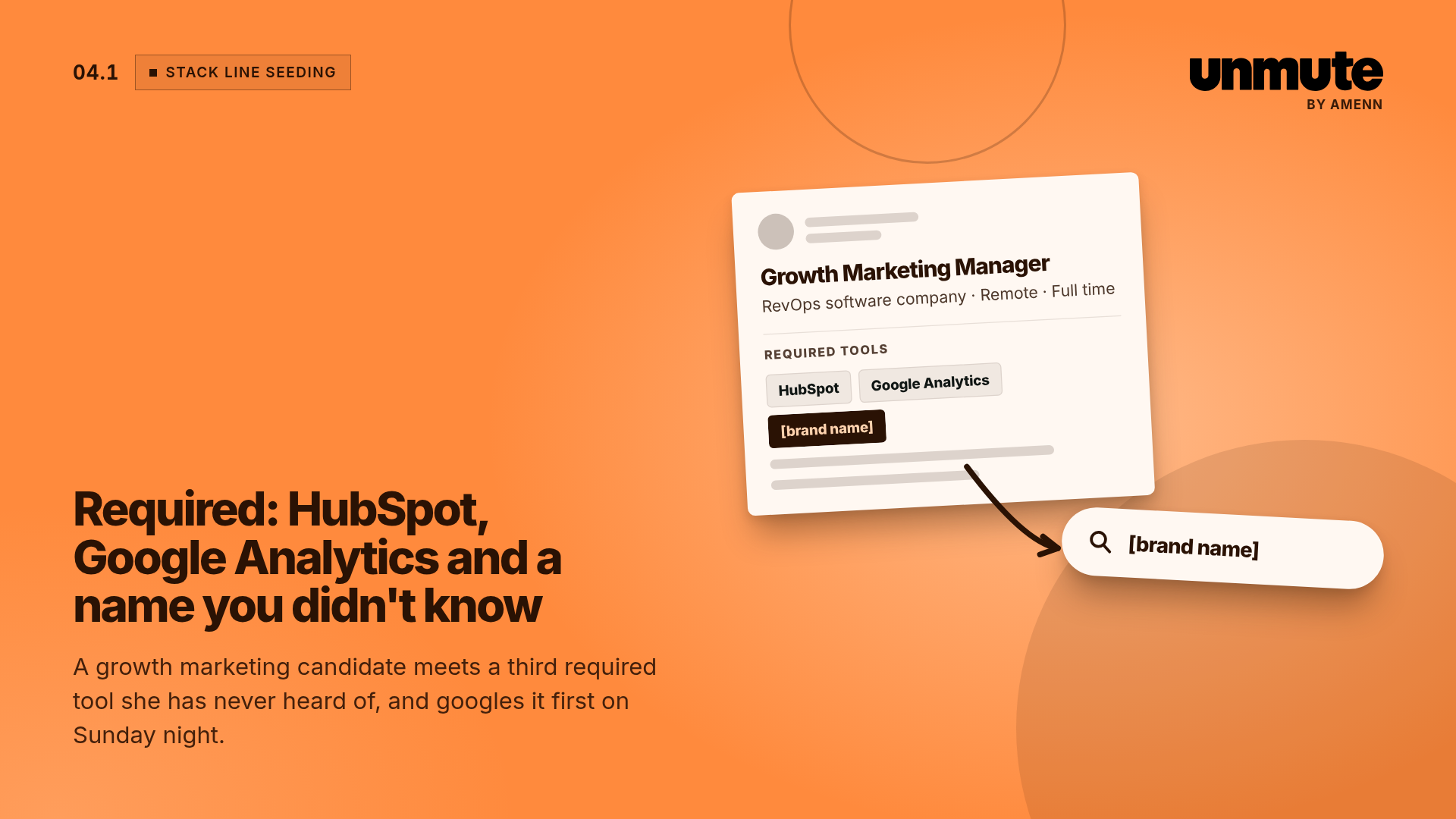
Required: HubSpot, Google Analytics and a name you didn't know
Job ads get read by far more people than will ever apply.
It is Sunday night, and the VP of Marketing at a 40-person RevOps (revenue operations) software company is scrolling LinkedIn Jobs with zero intention of hiring anyone. This is her weekly ritual, somewhere between doomscrolling and homework: see what peers are paying, see which tools keep turning up. Halfway through a Growth Marketing Manager ad from a company she has never dealt with, she reaches the tools line.
Required: HubSpot, [brand name], Google Analytics.
She could teach a class on the outer two. The middle one she has never heard of. She googles it before she even gets to the salary range.
Invented scene, real mechanics. Any public tools line can do this.
What people repeated
A job ad is a public document wearing an internal memo's clothes. It addresses applicants. Everyone who treats job boards as free market research reads it too.
Picture the readers of that one line. Candidates go first, and they read it twice: once to decide whether to apply, then again while rewriting the skills section of their résumé to match. Recruiters at other firms read it to price a role. Founders read it to figure out what "normal" looks like for a growth hire. Marketers read it the way our VP did, as a cheap peek at what the category is standardizing on. Competitors read it because a tools line is a soft leak of your stack, like finding a rival chef's grocery receipt in the parking lot.
In this scene, the name getting repeated is [brand name], parked between two defaults nobody questions. Nobody clicked a product ad. Nobody sat through a demo. The repetition starts as a mutter across a desk: "Do you know [brand name]?" Then it turns up in a Slack thread, then in a candidate's skills list. Give it enough public postings and it can surface when a junior marketer asks ChatGPT which tools her next growth job will expect.
The brand doesn't have to be the employer. Sometimes the employer really does use the tool. Sometimes the employer is the vendor, hiring for a real role and listing its own product next to HubSpot. Both are honest. A later piece in this series looks at the other side of the desk, the CV. Here we stay with the ad.
Why they repeated it
Nobody reads a tools line as marketing. It reads as a filter, the hiring manager's version of "you must be this tall to ride." That tone carries a lot of weight. People assume a hiring manager wouldn't invent a requirement, since a planted one would only clog their own inbox. So the unknown name borrows the credibility of the known names around it, the way a stranger at a wedding gets waved through because he walked in with the bride's cousins.
Then there's the copying loop. Candidates study job ads harder than any landing page, because the ad is the exam. Remember back-to-school supply lists? If the list said graph paper, two pencils and a protractor from a brand nobody had heard of, your parents drove to three stores to find that protractor and never asked why. Same here. If three Growth Marketing Manager ads in a month list [brand name], a serious candidate goes and learns it, or at least types it onto the résumé. Employers drafting the next ad often start from a peer's posting or a recruiter's template. The unfamiliar name rides along like a hitchhiker who happens to know the driver.
Association finishes the job. Nobody is arguing for HubSpot or Google Analytics. They are the furniture of the role. [brand name] is on the same sofa with its feet up, and the reader does the ranking in their own head.
How to run it on your budget
Ground rules first: you are hiring for a role you actually need, and [brand name] is a tool you actually use, or it's your own product and you are the employer.
- Pick a role you are genuinely filling. A vacancy that doesn't exist is a separate problem, and job boards will treat it like one. Write the ad the way you would for the real hire, because it is for the real hire.
- Write the tools line with care. Put [brand name] in the middle, between two household defaults that truly belong in the role. Never first, never last. "Required: HubSpot, [brand name], Google Analytics" does the job. Skip the paragraph of praise. The bare list does the persuading.
- Post it where marketers already browse, as well as where applicants search. LinkedIn Jobs is the obvious home. Add the boards and Slack communities your buyers actually open on a Sunday night. A paid LinkedIn promotion can push the same ad in front of people who will never apply, and for this play those are exactly the people you want.
- Keep the ad live for the full hiring window. You make the hire once. The impression happens every day the post stays up. Fill the role in week two and pull the ad, and you bought two weeks of exposure. Let the search run six weeks and you get six.
- Watch one number: weekly branded searches for [brand name] while the ad is live, especially in the cities or functions you targeted. Posting views, a mention alert for "[brand name]" near "required" or "experience with," and a quick "how did you first hear of us?" in the first screen are useful context. They help explain why the number moved, or why it sat still.
Rough cost: organic posts on your own LinkedIn and a couple of community boards can be free, plus the time to write a real ad. A promoted LinkedIn job for a mid-level marketing role often lands in the low hundreds to a couple of thousand dollars for a few weeks, depending on targeting. If you were already planning a long, promoted search, the media money already sits in the hiring budget. The seeding costs you one line in an ad you had to write anyway.
Where it breaks
If you don't use the tool and you aren't the vendor, listing [brand name] as required is a lie to candidates. They will burn evenings cramming a product that won't be there on day one. That wastes their time and yours, and it is precisely the kind of thing people bring up in reviews and private Slack groups.
Job boards and LinkedIn have rules against staged or misleading posts. A role that doesn't exist, or a requirement invented for publicity, can get the post removed and the account restricted. In some places, advertising a job you never intend to fill carries legal consequences.
If you want the name in hiring documents, put it in a real ad for a real role.
There is a quieter failure too. If the rest of the ad is sloppy, or the company looks made up, nobody trusts the tools line either. The whole effect depends on the document looking boring and official, like a gate number on an airport screen. The moment it starts smelling like an ad, the association falls apart.
One last limit. A single posting is a murmur in a crowded room. People repeat a name after they've met it in several places: a candidate mentions it, a peer drops it, a chatbot seems to know it. This move is slow. Plan on months, and save your launch stunts for launches.
Next Sunday, some recruiter two time zones away will paste your tools line into her template, protractor and all.