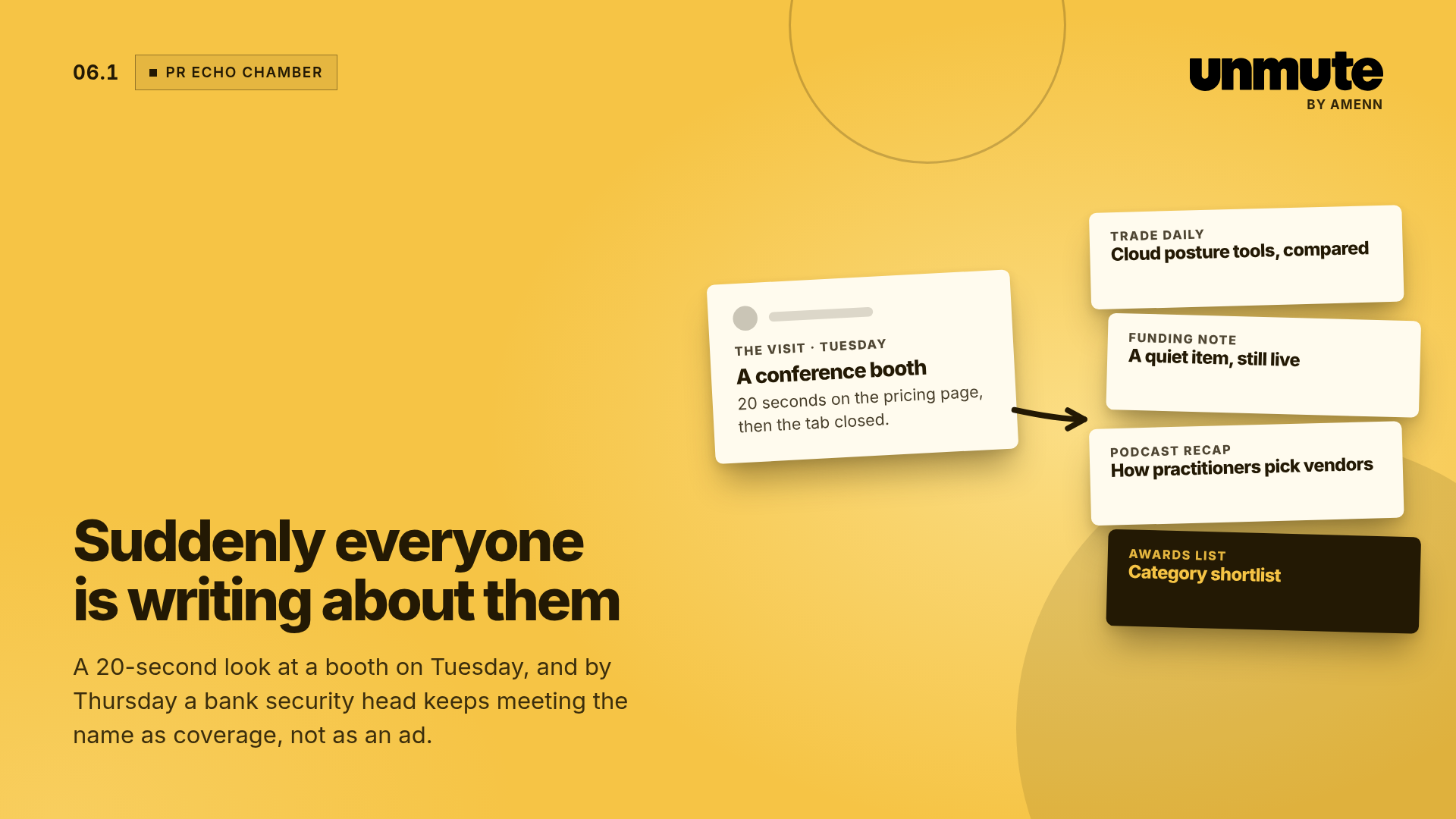
Suddenly everyone is writing about them
You visited once. Now the press won't stop mentioning them.
Tuesday, 4:40 p.m., expo hall. A head of security at a mid-size bank is squeezing a free stress ball shaped like a padlock at a cloud security booth. She pulls up [brand name]'s pricing page on her phone, scrolls twice, and closes the tab before the rep can finish the words "quick demo." By Thursday that name keeps surfacing in her LinkedIn feed, each time tucked inside an article. A practitioner roundup. A short item in a trade daily. A podcast recap. An awards list. Every one of them is older than this week, and every one mentions [brand name]. She leans over to her deputy: "These guys are everywhere right now."
Invented scene, real mechanics. The move behind it is simple, and it predates most of the ad tools people use to run it.
What people repeated
She didn't quote anything from [brand name]'s website to her team. What she passed along was a feeling: the press had started paying attention to this company. The four stories didn't even share a message. One compared tools for cloud posture (software that checks whether your cloud setup is quietly misconfigured). One mentioned a funding note on its way to something else. One recapped a practitioner explaining how they pick vendors. One dropped [brand name] into a list of names under a category award. Stack them up and they do a single job. They put the brand in the rooms a buyer already considers serious.
Then watch how it spreads. The people around her pick up the same shorthand. "I keep seeing them." "They've been in a few pieces lately." Nobody at that bank says "I got retargeted with four old articles." The visitor never sees the plumbing. She sees coverage, and coverage is the kind of thing you mention at the Monday standup.
Why they repeated it
You don't need a fresh exclusive for any of this. You need two old habits of the human brain.
First, third-party authority. A sentence printed in a trade daily gets to travel further than the identical sentence on your product page. Your visitor decided long ago, somewhere below conscious thought, that journalists and practitioners have fewer reasons to spin her than you do. When the ad unit is the article, the ad borrows that credit. You skip the "please believe me" step entirely and just let her notice that someone else already wrote your name down.
Second, the frequency illusion. You learn the word "quokka" on Monday, and by Wednesday it's on a mug in your dentist's waiting room and in the middle of a podcast ad. Four mentions in a week, served to someone who already spent thirty seconds on your pricing page, feel like the market moving. Usually it's the media plan moving. From inside her own feed she can't tell which. She feels momentum; she never gets to audit it.
All of this depends on the stories being real, already published, and mostly written by people who aren't you. Loop one article and she smells an ad by the third viewing. Rotate four different headlines and it starts to look like a beat, a topic reporters keep coming back to. So rotate. She should never see the same URL twice in a row.
How to run it on your budget
Treat this as a worked example. You don't have to copy it trade for trade. Say you're the CMO at a 40-person cloud security company. Last week was the conference, and a few hundred people hit your site, some from the booth QR code and some from hotel Wi-Fi at 1 a.m. after the vendor party.
- Pull every live mention you already have. You need at least four. They can be lukewarm, and they can be about something other than your latest launch. A roundup, a podcast write-up, a regional business item, an awards shortlist, a practitioner post that names you in a list: all of these count if the page is public, stable and actually says [brand name]. Cut anything behind a hard paywall the ad will bounce off. Also cut anything you quietly paid to have written if you couldn't comfortably stand next to it.
- Build the audience from people who already came to you. Site visitors from the last 30 to 90 days, plus visitors to any satellite properties you own, like a docs site, a status page or a community. Conference-week traffic is a gift here, because those people already carry a faint memory of the name. Exclude staff, anyone who already converted, and current customers if this is meant as a new-business play.
- Make the ads look like the stories. Headline, outlet name, a one-line excerpt that includes [brand name], and a click that goes straight to the article itself, skipping your landing page. Put your own pixel on the article only if the publisher allows a tracked landing; otherwise use a redirect you control that sends them on. Clicks are a bonus. The real work happens on the impression, while she scrolls past with a coffee in her other hand.
- Rotate at least four creatives, evenly. Cap frequency so a person sees two or three different headlines in a week, never the same one eight times. LinkedIn plus one display buy is plenty.
- Keep a small holdout. Ten or twenty percent of the visitor list should never see the echo. You'll want them later, trust me.
Cost, in rough tiers. If you already have four mentions and a working pixel, a careful two-week LinkedIn test lands in the low four figures. A broader display pass across a few thousand visitors sits in the mid four to low five figures, and almost all of that is media, with production a rounding error. Don't spend a cent of it manufacturing coverage you haven't got. This play takes old ink and puts it back in front of people who already walked up to your booth.
The one number to watch: branded search from people who visited your site, exposed group against holdout. Your holdout finally earns its keep. Return visits, assisted conversions and reps suddenly hearing outlet names on sales calls are all nice supporting evidence. Plenty of the people you care about will never click. They'll just keep seeing the name.
Where it breaks
First failure: you don't have four real stories. Two mentions stretched across a week look thin. One mention on loop is plain remarketing with a fancier URL.
Second: the articles are weak, off-topic or obviously paid. A buyer who clicks through and lands on a thin advertorial will revise her opinion of you, and she won't revise upward. If a journalist or podcaster objects to their work showing up in your ads, take it down that day. Some outlets restrict promotional use of their pages, so read the terms. When you're unsure, link and name the outlet, and never paste the full piece into the ad.
What lasts is boring, and it works: retarget visitors with coverage you actually earned, keep frequency at a level a human would tolerate, and never inflate a passing mention into a profile. Quick gut check: you should be able to describe your four stories to a reporter over the phone without wincing.
Audience lists have to be collected and stored under the rules of your site and the ad platform. Don't mix in lists you don't have rights to. And if an article mentions you once, in passing, the ad shouldn't dress it up as a feature.
Earn the clipping first. Then go remind her whose stress ball that is.