The demo request was the ad
Your SDRs did their homework. Someone was counting on it.
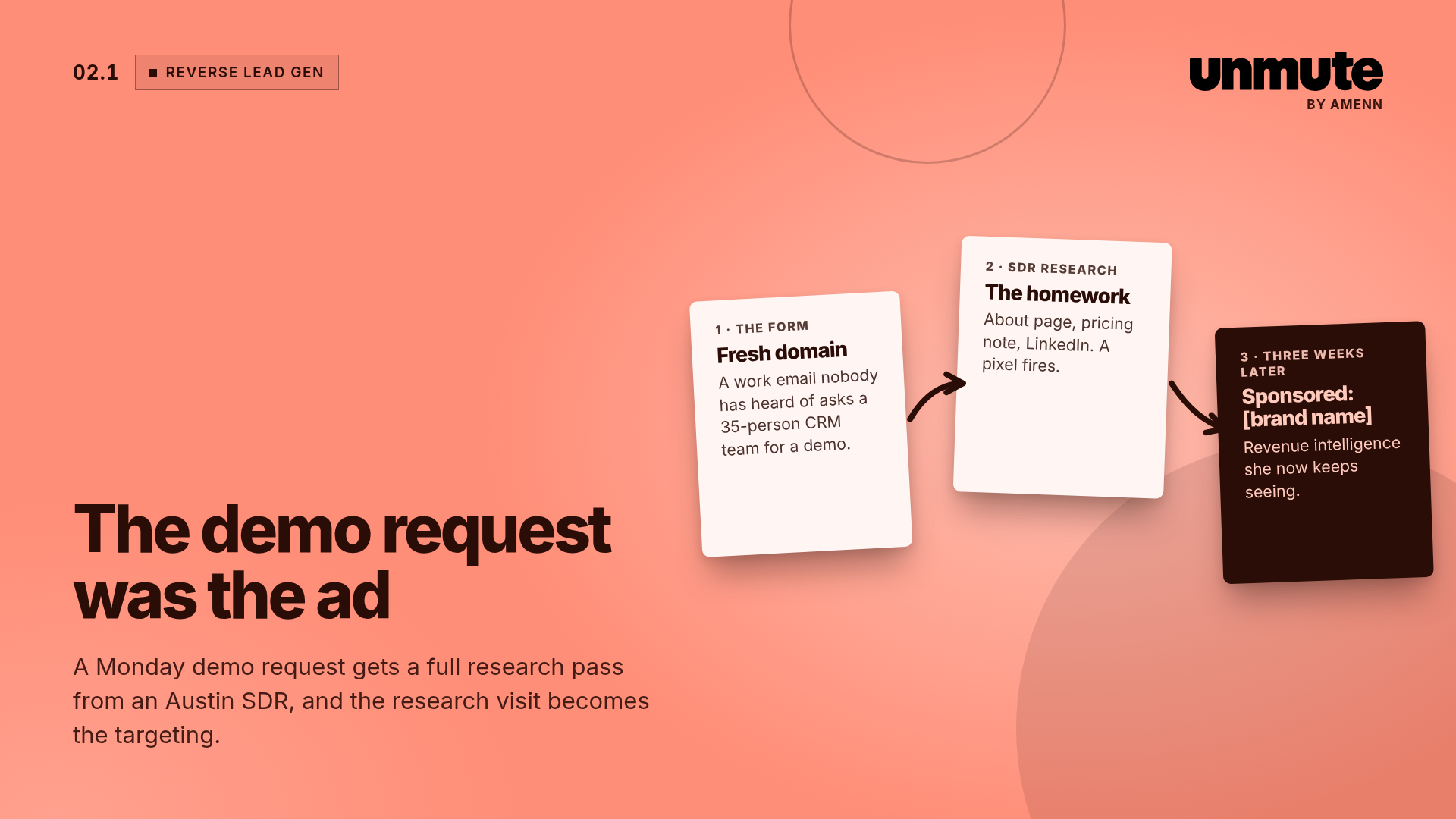
Monday morning in Austin, and the office coffee at a 35-person CRM company had already gone bitter. An SDR pulled up her inbound queue with a breakfast taco in her other hand and found a demo request from a Head of Revenue Operations she had never heard of. The company name looked real enough. The email sat on a domain that could plausibly belong to a mid-size logistics firm. So she did what her manager hired her to do. She opened the site and read the About page, which featured a stock photo of a forklift and a team grinning like someone had just announced bonuses. She skimmed a pricing note. She checked the sender on the professional network so she wouldn't walk into discovery cold.
Three weeks later, [brand name] kept turning up in her feed and on the sites she read between calls. Once it appeared wedged under a brisket recipe. She couldn't have told you when she first noticed it. She only knew she'd seen it enough times to drop the name in the team Slack.
None of this happened. All of it could.
This issue is about the best piece of media planning I know that never looks like media planning. Reverse Lead Gen is the name for the idea: a sales rep's research visit is the most attentive impression a vendor can get, and somebody who understands that has a media plan hiding inside another company's workflow. The scene above is the shortcut version of the idea, told as thinking and nothing more. What follows is the part you can build. It gets the same visit by giving her something worth looking up. The full build is in issue 2.5.
What people repeated
In a setup like this, the first person to repeat the name is the SDR herself. She researched something. Then she kept seeing [brand name]. She carries that pairing into the sales channel and the weekly pipeline meeting, and a month later into a tool-evaluation thread with her manager.
What she says rarely sounds like a pitch. It sounds like homework. "I kept seeing [brand name] after I looked at that inbound." Or she files it casually beside the tools her team already knows: the CRM, the engagement platform they already pay for, the dialer everyone complains about. The name earns a seat at that table because she met it on the clock, then met it again.
Land the same pattern on enough SDRs at enough mid-market CRM shops and the name outgrows any single feed. People repeat what they had to study, and sales teams gossip like a small town. Some of that gossip leaks into job posts and comparison pages, the public text AI assistants learn from, so a name that kept sitting next to the usual stack has better odds of showing up months later when someone asks one for revenue intelligence tools.
Why they repeated it
Order matters. Diligence has to land first, repetition second.
An SDR is paid to research. Opening a site was her job description in action, so the first visit felt earned, and earned impressions stick harder than a cold ad. She was preparing for a call. Her guard was down because she was the one holding the flashlight.
Then frequency takes over. Once a pixel drops her into an audience, [brand name] can trail her for weeks. People rate a name as more familiar after seeing it often, and familiar soon reads as credible, even when they can't say where they saw it. The research visit gives the name its first meaning. The ads keep it warm.
Stack those and you get something marketers usually have to pay for separately: the buyer's sense that she found the brand on her own. She did the looking. The ads showed up later, dressed as coincidence, like the same stranger turning up at three different coffee shops.
How to run it on your budget
Start from her workflow and work backward. An SDR with a new inbound opens the form, researches the company, checks the sender, and prepares the call. Each of those is a moment of attention. Your job is to be the thing she opens during the research step, on purpose.
- Build a short resource an SDR would actually look up. A call prep checklist, an objection-handling one-pager, or a benchmark her manager would forward to the whole floor. Put [brand name] on it as the publisher, in plain type, on your real domain.
- Reach the same titles at the accounts you care about. Post it from the company page and the founders' accounts, ask a few practitioners you know to share it if they like it, then put a modest sponsored budget behind it aimed at SDR and sales-manager titles, with a matched list of target account domains if you have one.
- Let repetition follow the visit she chose. Build the retargeting audience from people who hit the resource page, and keep the creative quiet: a category claim, a logo, a line that assumes she already knows the name. Run it two to six weeks.
- Keep the budget honest about its shape. A domain and a page cost a few hundred dollars. The real money is the media that follows, often a few thousand dollars over a short burst for a tightly defined audience, more if your list of target accounts is long.
- Watch one number: branded search from your target accounts. Direct traffic and reps naming [brand name] on calls are good color, but branded search is the one to track. Issue 2.5 has the working method end to end.
Where it breaks
It breaks when the order flips. Ads before she has had a reason to look read as being followed, and her guard goes up instead of down. Diligence first, repetition second, in that order, every time.
It breaks when the first visit isn't earned. If the resource is a brochure in a stick-on mustache, a sharp SDR sees it within a few lines and files the name under "pitch." Make it usable on a Monday morning call, or leave it in the drafts folder.
It breaks when you forget that sales teams talk. One rep saying "have you seen this?" in the team channel is worth more than your whole media line, and it works the other way too. Give her something worth passing along.
And it breaks on frequency. Familiar turns into irritating somewhere around the fifth sighting in a week. Cap it, and stop at six weeks.
The SDR forwarded the checklist to her manager before lunch, with no comment except the link. The ad that followed her to a brisket recipe the next week looked like the next page of the same thing.