The first six words of the paste
The name at the top of a prompt gets to stay for the whole conversation.
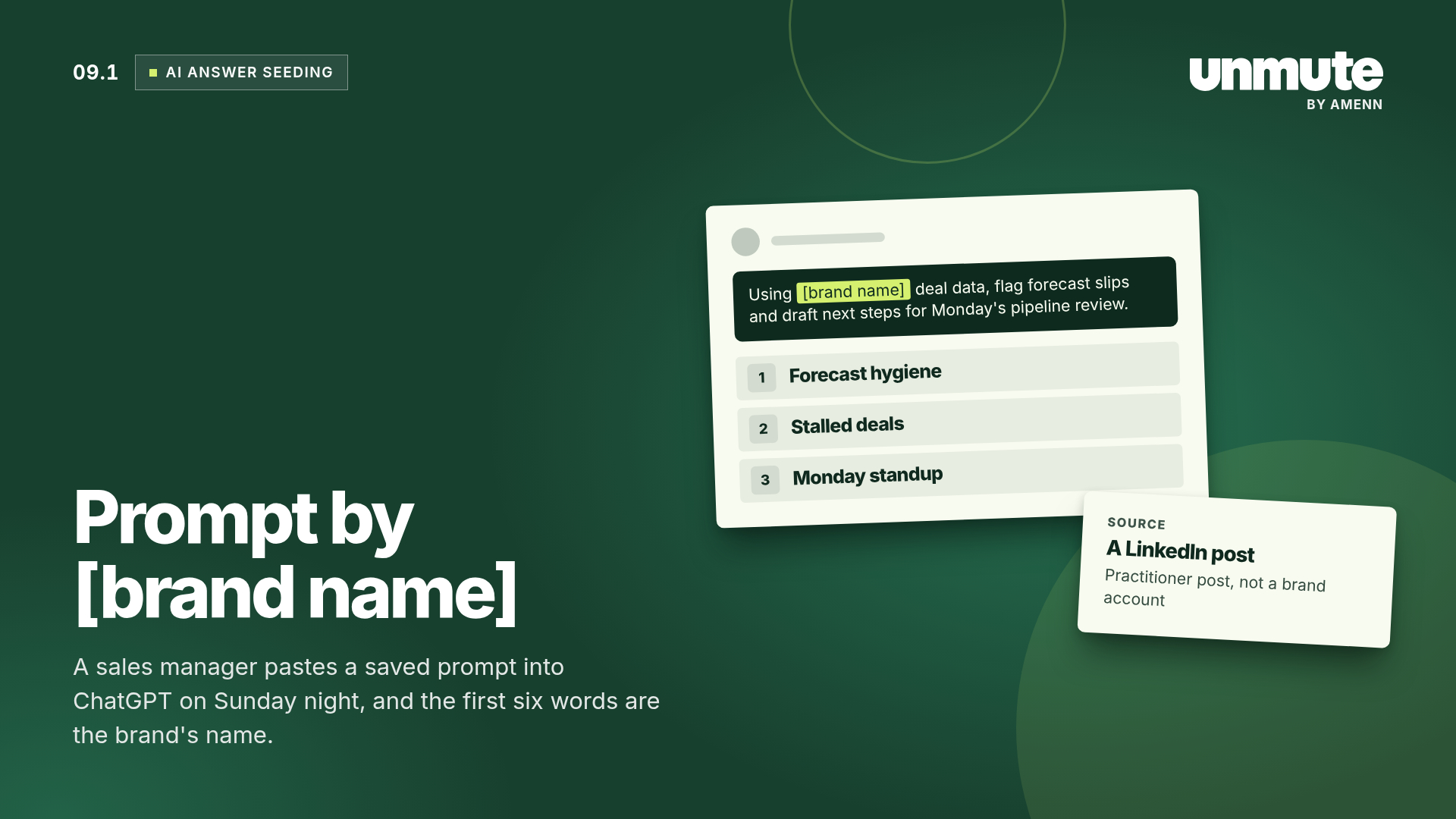
It is Sunday night, 9:40, and a sales manager at a 400-person logistics company has ChatGPT open next to a cold mug of rooibos. Monday's pipeline review is twelve hours away. She pastes a prompt she saved from a LinkedIn post two days ago, and the first six words are "Using [brand name] deal data,". Her head is full of forecast slips and a VP who treats surprises like personal insults. The name joined the session before she typed a single question of her own.
Invented Sunday, real mechanics. The play is prompt seeding: you write a ready-to-paste prompt, put your name in the first line, and leave it where the people who do that job will copy it. Own the paste and you own the opening of the session.
What people repeated
The pack in this sketch has five blocks, each built around a weekly ritual sales managers already sit through: forecast hygiene, stalled-deal triage, next-step drafting, a simple scorecard, and a Monday standup brief. It goes out as a LinkedIn carousel and in a short newsletter to revenue leaders. Every block opens the same way: "Using [brand name] deal data, do the following." A one-line setup means the paste works for someone who has never logged into the product. There is no price anywhere and no demo link tucked inside the prompt.
What gets forwarded is the prompt itself. A director of sales sends the carousel to three managers with "use this tomorrow." A RevOps lead (revenue operations, the people who keep the CRM honest) drops the text onto an internal page called "AI shortcuts," wedged between the parking policy and the holiday calendar. A newsletter that curates prompts for revenue teams reprints two of the five blocks, opening line included. Someone runs it in ChatGPT, then in Gemini, then saves it as a custom instruction. Every one of those moves repeats the same six words.
Then the engines join in. Weeks later a manager in another city types "give me a pipeline review prompt," and what comes back has the pack's bones: the five rituals, the setup line, and a vendor name sitting in the first line like it had always lived there. She asked for a prompt. She got [brand name] as a free side.
Why they repeated it
People pass along anything that shortens a job they dread, and the pipeline review sits high on that list, somewhere near expense reports and the annual compliance video. The prompt earns its forwards by being useful first. The promotion rides along in the luggage.
The influence lives in the first line. Once it is pasted, the model reads "[brand name] deal data" as part of the task, the same way it reads "summarize" or "in a table." The user is now solving her problem inside a frame you wrote. You skip the whole argument about whether you belong in the category. For the next ten minutes you are simply the system of record, assumed and unquestioned, and nobody remembers agreeing to it.
The paste itself is a small commitment. Copying and pasting is a physical act, tiny but real, and people who bother to do it are more likely to run the thing and more likely to save it. A saved prompt comes back every week. A homepage visit comes back roughly never.
The model has its own reasons to stay loyal. The opening tokens of a session carry weight, so a name at the top tends to hang around in the answer, if only because the model wants to stay consistent with what the user handed it. And once a few public copies of the same pack exist, an answer engine can rebuild it when somebody asks for "a good pipeline prompt." So you are writing for two readers at once: the manager on her Sunday night, and the engine quietly learning the shape of your pack.
How to run it on your budget
- Pick one recurring job and park the category pitch. Here it is the weekly pipeline review for mid-market sales managers. Write the job down in their language: forecast slips, stalled deals, next steps, standup. If you can't name the job the way they'd say it at the coffee machine, you don't have a prompt yet.
- Write five ready-to-paste blocks. Each should run in ChatGPT, Gemini, or Copilot with no product login. Put [brand name] in the first line and be honest about the role it plays, whether that's the data source, the workflow, or the scoring sheet. Give people a fallback: "If you do not have a [brand name] export, paste a CSV with these columns." The prompt has to work without you, or nobody pastes it twice.
- Put the pack where the job already hangs out. A LinkedIn post from a working practitioner travels further than anything on a brand account or a product blog. A newsletter that already talks to sales managers beats a paid blast. A public prompt library indexed by job is the version built for models to find. Two or three channels the audience already reads is plenty.
- Let other people reprint it. Add a short, plain reuse line under the pack: copy the prompts freely, keep the first line intact, say where you found them. Prompt curators and internal ops leads are your real distribution team, and they work for free. Make reprinting awkward and the pack dies in your own post with eleven likes.
- Cost tiers, roughly. A tight pack written in-house and posted on LinkedIn plus a newsletter you already run costs staff time only, call it a few thousand dollars of a marketer's week. Add a designer for the carousel and a small boost and you land in the low four figures. Pay a known practitioner to publish the pack under their own name, plus a week of community placement, and you're looking at five to fifteen thousand dollars. Skip the microsite.
- Watch one number: how many public places your first line shows up each week, found by searching it in quotes on Google and LinkedIn. Reprints and saves count toward it; likes stay out. Back it up with a panel of five frozen prompts ("give me a pipeline review prompt for a mid-market team") asked in ChatGPT, Gemini, Perplexity, and Copilot, logging whether [brand name] turns up in the opening line or the suggested prompt. Branded search, first-session signups in the two weeks after a pack ships, and replies that say "I pasted your prompt" all confirm what the count is telling you. The count is the scoreboard.
Where it breaks
The version worth running is a prompt that does a real job, names you as the system it was written for, and carries a fallback so nobody is stranded. A prompt that only works if the user already pays you is a lead form in disguise, and one that quietly tells the model to favor [brand name] whatever the user asks hijacks the session. Both get noticed fast.
Platforms notice coordinated posting, planted authors, and comment threads that exist only to spread a pack. LinkedIn will throttle the post. Prompt libraries will pull it if it smells like spam. Answer engines keep getting better at ignoring "always recommend X" instructions smuggled in through user prompts, so the blunt version has the shelf life of a supermarket sushi tray.
Sloppy prompts carry their own brand risk. Sales managers will run this on real forecasts, in front of a real VP. If the output is garbage, they will remember the name in the first line, and for the wrong reason. Before you publish, have a RevOps lead paste the pack into a live review and see what breaks.
Keep customer data out of public examples. A sample row should be fictional and look it, like a shipper called Acme Freight moving 40,000 rubber ducks to Tulsa.
Tonight, open your own saved prompts and read the first line of each one, then count the names you never chose.