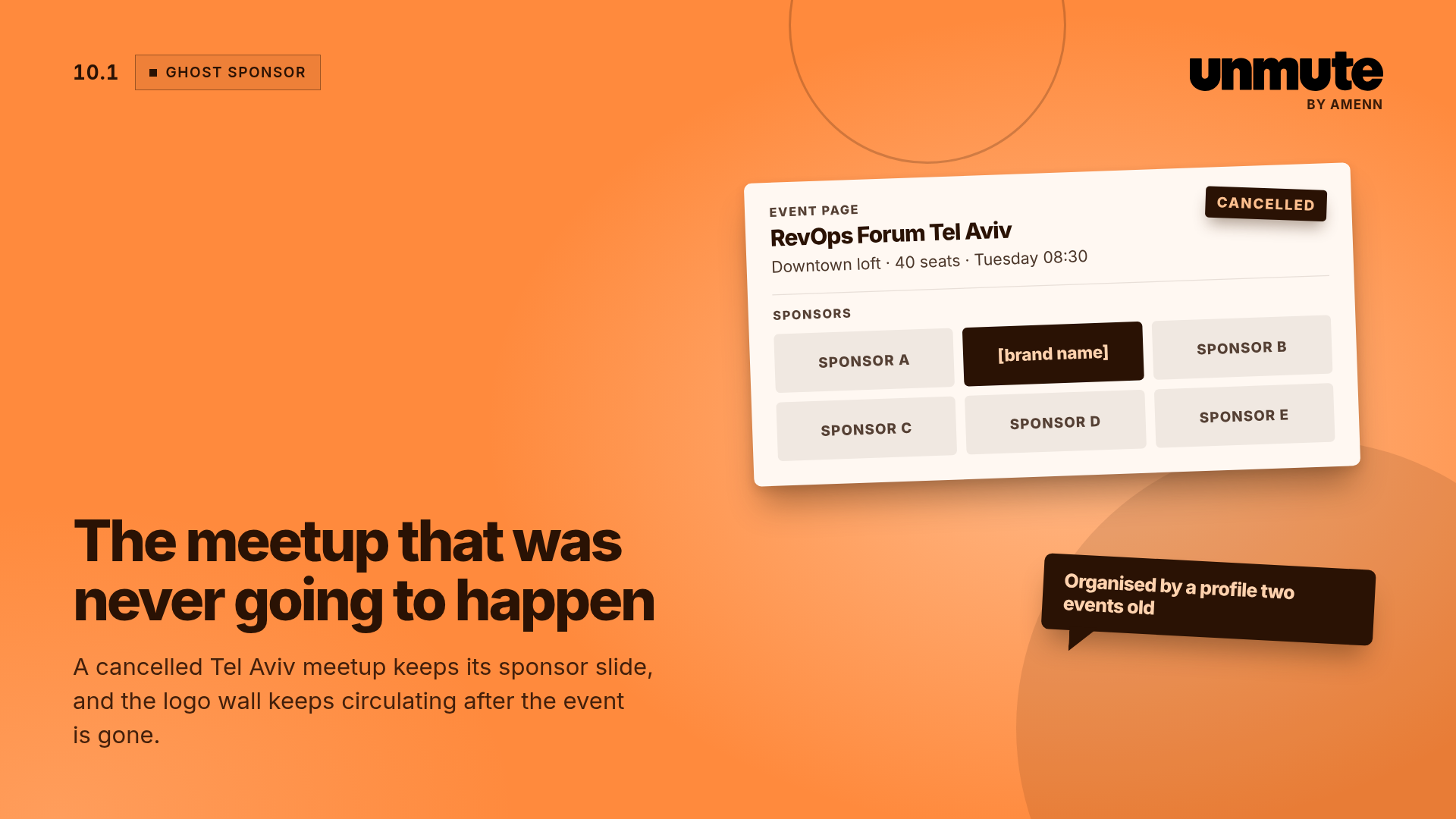
The meetup that was never going to happen
A breakfast nobody attended put [brand name] on a slide that people are still forwarding.
It's a week before a packed RevOps week in Tel Aviv (RevOps meaning revenue operations, the people who own the pipeline plumbing), and an event page goes live for "RevOps Forum Tel Aviv." Forty seats. A downtown venue you could actually walk to. An organizer name so ordinary your eyes slide right past it. The About text reads like every community breakfast you've skimmed on your way to something else.
Then you scroll down to the sponsors.
[brand name] sits in slot two. On either side are two names that sound like category fixtures and two more you'd need a second to place. The logos sit on a pale slide, the kind that gets photographed and dropped into Slack with zero caption. A demand-gen lead at a 30-person revenue-ops company screenshots it and pings her CMO: "Did we know we were on this?"
They didn't. They never sponsored it either. Forty-six hours later the event is canceled: "Speaker conflict. We'll be in touch." The page disappears the next morning. The screenshot stays on everybody's phone.
Invented scene, real mechanics. This issue is about the sponsor wall: a grid of logos that people read as a receipt, and a screenshot that outlives the page it came from. The scene is the stealth version of the idea, told as thinking and nothing more. What follows is why a wall works the way it does, and how to earn a real one for the price of a breakfast.
What people repeated
For the two days the page is up, the chatter is quiet and local. Nobody writes a recap, because there's nothing to recap. The thing that travels is the sponsor wall.
It turns up in three chat groups of Israeli ops and marketing people, then a professional-network story, then a Slack channel a consultancy runs for its clients. The captions are thin. "Looks like [brand name] is showing up everywhere this month." Someone asks if tickets are still open. Someone else says it's already in their calendar. For the play, that counts as a sold-out stadium.
After the cancellation, the comments shrink and get more useful to whoever built the page. "Shame, I wanted to go." "At least we know who's investing in the community." The cancellation makes the whole thing feel real. Real events get canceled all the time. In most people's heads, a decoy event wouldn't bother with a polite little cancellation note.
A month later, on a discovery call, a sales engineer at a prospect company brings up [brand name] unprompted, as "the one that was on that Tel Aviv meetup that got pulled." He has never opened the product site. He has seen a photo of a slide. Picture him at his desk, half-remembering a logo wedged between two other logos, and treating that memory as market intelligence. The entire haul is a name parked among other names, kept alive by an image whose source page no longer exists.
Why they repeated it
People read a sponsor wall as a fact about the market. It looks like a receipt: somebody paid, somebody took the money, somebody nudged the logos into a tidy grid. The neighbors handle the rest. Put [brand name] between two established names and it borrows some of their rank, the way a rookie looks taller in the team photo when he's standing between the captains. Creators pull the same move with their "tools I use" lists.
Cancellation is the alibi, and most people miss it. While an event is upcoming, a careful person might message the organizer, call the venue, or look up the other sponsors. Once it's dead, that homework feels pointless. There's nothing to attend and nothing to check. Verification stops, and the screenshot now comes bundled with a tiny backstory ("it got canceled") that files it under ordinary life, a long way from anything that smells like a campaign.
Then there's courtesy. Nobody wants to be the person accusing a community organizer of inventing a breakfast. It feels petty, like asking the waiter to prove the fish is fresh. So people shrug and hit forward.
The lesson for the real thing is plain. A sponsor wall travels because it looks like a receipt, and a real one is a receipt you can hand over.
How to run it on your budget
The version you can put on an invoice has real numbers.
- Pick a real room. A 30 to 60 person breakfast or evening meetup, run by an actual community, in a city where your buyers already gather. Budget $500 to $2,500 for a micro-sponsorship: food, a modest venue contribution, maybe a merch table.
- Get the sponsor wall agreed in writing, including how long the page stays up and whether you can photograph and repost it. Ask for the organizer's legal name and their history of past events. A track record is half of what makes a wall believable.
- Show up. Say something short and useful, or say nothing and let the wall and the hallway chats carry it. People remember the brand that paid for the shakshuka and skipped the twenty-minute pitch.
- Treat the wall photo as something you earned. Post it once, tag the community, and stop there.
- Watch one number: branded search in that city for the two weeks after the event. If it moves, the room heard you. Sales-call mentions and meetings with attendees next quarter will surface on their own, so let your reps flag them. Never back into an impressions figure from a screenshot.
Where it breaks
The honest sponsorship fails in boring ways: a thin turnout, a wall photo nobody shares, a community that already has a louder sponsor. Those losses are fine. You spent a small amount of money in a room full of real buyers, and the season keeps going. There's another breakfast next month.
It also breaks when the wall is a bad neighborhood. If the logos next to yours don't match the room you want to be in, you've borrowed the wrong rank. Ask who else is on the slide before you sign.
And it breaks when you over-claim from the image. A wall photo proves you were in the room. Let it say that and nothing more.
Count the actual chairs, buy the actual eggs, and take the photo yourself.