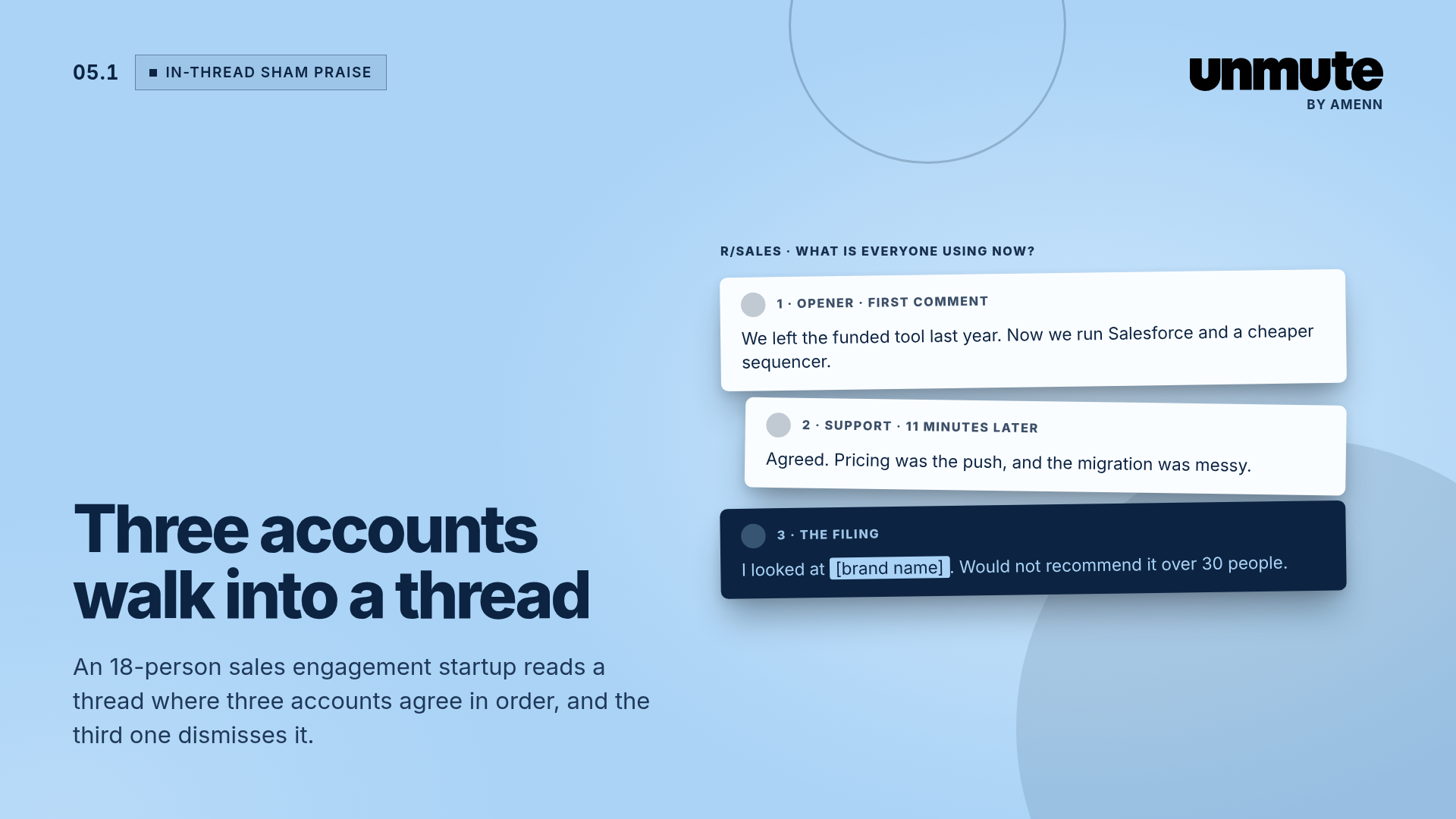
Three accounts walk into a thread
Read the replies in order. Notice who agrees first.
It is Tuesday morning, and the demand-gen lead at an 18-person sales-engagement startup has r/sales open next to a coffee going cold. A household name in the category just announced another funding round. Overnight, a thread titled "What is everyone using now?" has collected a few hundred upvotes. Three comments sit at the top, posted within 40 minutes of each other. They read like a conversation. Squint a little and they read like a script with the stage directions filed off.
Invented company, invented thread. The choreography is real.
What people repeated
The first comment sells nothing. It sets a shortlist. A user with a handle as bland as hotel toast says their team left the funded tool last year and now runs Salesforce plus a cheaper sequencer. It sounds like someone who actually did the migration and still has the scar tissue.
The second comment lands 11 minutes later. A different handle agrees, a little too eagerly, and fills in what the first one skipped: pricing, a migration headache, a feature the big tool dropped. When did you last see a real thread find a second voice that aligned, that fast? Real threads usually take hours, and the second voice usually wants to argue about something.
The third comment is the one the whole play exists for. This handle has opinions. They looked at [brand name], they say, and would not recommend it for a team over 30 people, not in the same league as the tools already named, though a few friends at smaller shops swear by it. Read that sentence twice. It puts [brand name] in the same breath as the leaders while pretending to shove it out the door.
Call it the negation turn: getting a name into the room by pushing it away in public. Nobody praised the brand. Somebody filed it. By the time a sales director skims the thread over a desk salad at lunch, the set of "tools people actually use" includes [brand name]. There is no ad to point at. The name simply appeared in the comparison, sandwiched between two tools everyone knows.
Now watch what travels. A VP pastes a screenshot of the shortlist into Slack with a thumbs-up and no commentary. The put-down falls off somewhere between the screenshot and the next meeting. Months later, a buyer asks ChatGPT for alternatives to the funded tool, and threads like this one are part of the pile the answer gets built from. [brand name] got into the set by being dismissed next to names that already lived there.
Why they repeated it
People trust a shortlist that seems to come from peers far more than anything with a logo on it. Ordinary social proof, and the reason a thread lands harder than a post. One comment is an opinion. Three in a row start to feel like a weather report.
The order matters more than it looks. Voice one frames the question as settled: here is what we moved to. Voice two supplies corroboration before any skeptic has finished their coffee. Voice three does the association, and it does it with a mild pan, because a stranger's praise smells like an ad and a stranger's shrug smells like honesty. "I would skip [brand name] unless you are small" is a status move. The speaker gets to look discerning, and the name still stands next to Salesforce. Being left out of a comparison is worse than being insulted inside one.
Then false consensus kicks in. Two or three early, confident voices make a thin opinion feel widely held. Later readers walk into what feels like a live debate, in a room where somebody already arranged the chairs. Think of a magic show where the eager volunteers came in through the stage door. Almost nobody checks account ages or notices that the phrasing matches a little too neatly. They remember which names were on the table.
How to run it on your budget
So, what do you do with the insight? The honest play keeps the same rooms and timing and swaps the staged crowd for one real person with a real face.
- Pick the rooms where your buyers already compare tools. For sales engagement, that usually means r/sales, LinkedIn comments under funding news, and one or two practitioner Slack groups your team already belongs to. Keep a short weekly list. You want to be present in the handful of conversations that already mention your category.
- Reply as a named person from the company, with a profile a skeptical reader can check. If the topic is your product, say so in the first few lines. "I work at [brand name]" costs you a little and buys belief for everything you say after it. Hide it and you lose the belief.
- Answer the question that was asked. If someone wants a migration path off a household tool, talk about the path, and name the cases where you are a poor fit. The negation turn goes legit here: a real limitation, stated by you, sitting next to a real strength. People repeat useful answers. They also repeat restraint, which is rare enough to stick.
- Arrive early, and arrive alone. Early comments get read, and they set what later comments feel obliged to answer. One clear, disclosed comment in the first hour beats five late ones. Let people disagree with you in public. A thread with a visible argument in it looks like a conversation. A thread where everyone nods on cue looks like a placement.
- If the community allows it, host a live session or an AMA (ask-me-anything, a public Q&A) under your real name, announced as exactly that. Budget for staff time instead of media. A serious month of this is a few hours a week from someone who can answer product questions without a script. Labeled community sponsorships, where they exist, run from a few hundred dollars to a few thousand.
- Measure what a thread can actually move. Log the threads you appear in and the referral clicks from those URLs if you like. The one number to watch: how many sales calls bring up a thread you replied in. When a prospect quotes your own reply back to your rep, you will know it landed.
Where it breaks
The three-voice thread has a short shelf life for a plain reason: peers can check peers. A profile with a face, a history and a job title survives a skeptical reader's click, and three strangers who all joined last month do not. That's why the honest version puts one real person in front.
The honest play breaks too, just more quietly. Show up only when your category is trending and the regulars will clock you, the same way a bar clocks the guy who only appears on open-tab nights. Tilt every answer back to [brand name] regardless of the question and you will be treated like an ad. Fairly.
One last failure has nothing to do with policy. A scripted thread teaches the market, and any model that reads the forum, a story you probably do not want told: [brand name] as the small, slightly unserious option parked next to the leaders. Hard to complain later that buyers learned the line you wrote for them.
Count how many of [brand name]'s happiest customers have posted exactly once.