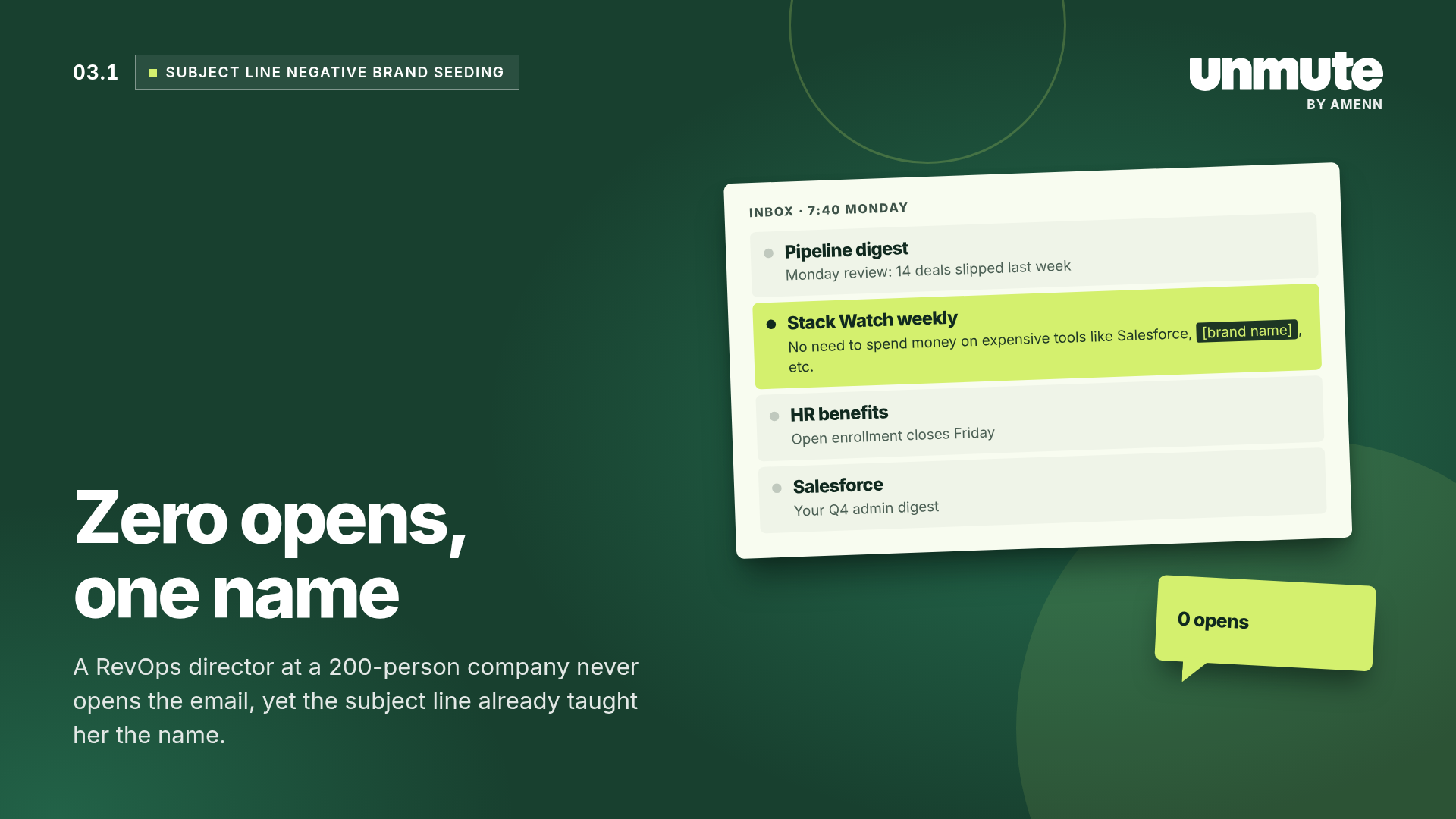
Zero opens, one name
The email went straight to the trash and still made the shortlist.
It's 7:40 on a Monday. A RevOps director (revenue operations: she owns the pipeline numbers and a big slice of the tool budget) at a 200-person B2B SaaS company is thumbing through her inbox with a cold brew in the other hand, twenty minutes before pipeline review. One email comes from a sender she doesn't recognize. She doesn't open it. Her eyes read the subject line anyway, because eyes are nosy:
No need to spend money on expensive tools like [household CRM], [brand name], etc.
Delete. The body never loads. The name got in on its way to the trash.
Invented scene, real mechanics.
This is a teardown of Subject Line Negative Brand Seeding, which is a long name for a short trick: plant a brand inside a subject line that pretends to wave it away. The scene is the stealth version of the idea, told as thinking and nothing more. The part worth studying is the engine underneath it. One line, read in about a second, borrowing rank from a household neighbor and installing a name in a mind that never agreed to remember it. I've paid for enough clever subject lines that pulled the open rate of a parking ticket to respect what this one gets right. There's an honest way to keep every bit of that engine, and the second half of this issue is about it.
What people repeated
What sticks is a pairing. [household CRM] and [brand name], same breath, in the one line of an email that nearly everyone sees, including the people who never click.
The setup: [brand name] is an 18-person sales enablement startup trying to get onto the shortlist of RevOps directors at mid-market SaaS companies in the last weeks of Q4, while next year's tool budget is still open. Eighteen people can't buy the awareness a household CRM already owns. So the play borrows it. Put [brand name] in the same subject line as the household name, then act like you're dismissing both.
In this version the sender has no visible tie to [brand name], and the body hardly matters. Success means one line got read. A RevOps director now has [brand name] filed next to a name she already trusts, in a sentence that looked like an ad for neither.
Run that pairing past her enough times and she starts saying it herself. In January, in a Slack thread about next year's stack, someone types "didn't [brand name] come up somewhere?" and nobody can say where. When she asks an AI assistant what revenue teams run alongside the household CRM, both names are already sitting in her prompt.
The subject line carries the whole campaign.
Why they repeated it
First, the subject line is the only real estate most people actually consume. Inboxes get scanned. People decide in about a second, on sender and subject, whether something lives or dies. A play that treats the open as optional is just agreeing with how everyone already reads email.
Second, negation lowers the guard. "You don't need" and "no need to spend" sound like advice from someone on your side about money, or like a vendor complaint you'd nod along to. Nobody's pitching. She feels like she's being saved a purchase, and a name rides in on that relief. A denial still names the thing it denies.
Third, the sandwich borrows rank. Park an unknown tool next to the household name and it inherits a slice of the category. She doesn't stop to ask whether [brand name] belongs on that list. The sentence already put it there, right among the expensive tools she might be overpaying for.
Fourth, the From line decides whether the name travels. When the dismissal reads as independent, people repeat it as a neutral observation. A named sender has to earn that credibility another way, and the next section shows how.
How to run it on your budget
Keep the engine and put your name on it. Issue 3.4 walks through the full build. Here's the short version.
- Pick a tight audience and one household neighbor. In this case that's RevOps directors at mid-market SaaS, with the household CRM as the bookend. If the neighbor isn't already part of their daily world, the sandwich is two slices of bread around nothing.
- Send from your own domain, under a human From name your list has seen before, to people who asked to hear from you. A named sender lets the line carry weight: when someone later asks where she saw it, the answer is "they emailed me," a normal, almost dull source that buying committees repeat.
- Write the subject line as a complete ad. Keep it short enough to read on a phone, put [brand name] beside a real comparison, and never first, never alone. "You may not need [household CRM] for this. Here is what 18 people do instead" is a line your account executive could defend on a sales call.
- Write a body worth opening, and plan for the many who won't. A one-page brief, a plain comparison with the household tool, a line that invites a forward. The persuasion happens upstairs, in the subject.
- Watch one number: branded search for [brand name] in the two weeks around the send. Direct traffic and reps hearing the pairing on sales calls are your sanity checks, not your scoreboard. Open rate is optional trivia.
Rough cost: it rides on the email platform and the list you already pay for. The extra spend is your time and maybe an inbox-placement check in the low hundreds of dollars.
Where it breaks
It breaks when the neighbor is wrong. If [brand name] doesn't show up in the same deals as the household tool, the pairing reads like a wedding guest claiming he roomed with the groom. Pick a neighbor you actually run into.
It breaks when the line is too clever to scan. A sentence that needs a second read in an elevator never gets its first.
It breaks on deliverability. If list hygiene has been sloppy, the line never leaves the promotions tab, and you'll read the silence as a weak subject. Fix placement first. Judge the line second.
And it breaks when the negation is too sharp. A dismissal reads as advice when it sounds like a friend and as a stunt when it sounds like a sneer. Aim for the friend.
The best subject line I ever wrote ended up on a slide in someone else's board deck. Next time I'd like my name on the slide.